
From the Isiagu in southeast Nigeria to the Iro and Buba popular with the Yorubas in the southwest, our traditional Nigerian attires are one of the last and strongest ties that serve to continually remind us of our culture and heritage as the wind of civilization and so-called technological advancement continues to blow
Our traditional Nigerian attires symbolize our unique national identity and our beautifully diverse culture with symbols and elements that tell the story of our history. For instance, the coral beads worn by the Edo people of southwestern Nigeria are a symbol of freedom and royalty.
Related; What to wear in Nigeria; The Complete Packing Guide for every Visitor to Nigeria
You can recognize an Urhobo man in a sea of people dressed in English or Western attires if he dresses in his native gown and colourful coral beads
Nigeria has over 250 ethnic groups, within which there are over 527 languages and 1,125 dialects. Each of them has its culture and traditional way of dressing which sets them apart from others
But asides from the core traditional Nigerian attires that the various ethnic groups have been known for, we also make a big deal out of the Ankara fabric, which, even though does not have its roots in Nigeria or Africa, has come to be so closely associated with our Nigerian culture
Nine out of ten Nigerians have a rich collection of colourful Ankara fabrics sewn into different styles and worn on different occasions, including to places of work. It is a known fact that some of our traditional attires have elements of ankara in them
Unlike the core traditional attires which are a bit sophisticated and are different from ethnic group to ethnic group and worn mostly on special ceremonial occasions like a traditional wedding, the Ankara fabric is not culture-specific and can be styled in various ways and worn to just about anywhere.
However, wearing Ankara still reflects our culture and pride in it, unites us as Nigerians and sets us apart from the western culture.
WHY WE LOVE OUR NIGERIAN TRADITIONAL ATTIRES (THE IMPORTANCE OF WEARING TRADITIONAL ATTIRES IN NIGERIA )

As you must already know, dressing in our traditional attire in Nigeria goes beyond the human need to cover themselves or even for fashion purposes. A Nigerian on a cultural attire conveys different underlying meaning beyond merely looking fashionable, even though this is one of the reasons – dressing in our traditional attire sure makes us look beautiful.
- Traditional attires represent our unique identities; This is true for us, as it is in other climes. The Indians are known for their heavily and colourfully embroidered saris, the Chinese wear their Hanfu, Zhongshan suit (Mao suit), Tang suit, and cheongsam (qipao) and the Ghanaians are known for their kente. These traditional clothes cannot be separated from who they are – it is their identity.
- Traditional attires remind us of our heritage and help us to preserve our cultural norms and values; The Nigerian culture is rooted in values and norms that set us apart from other cultures in the world. Agreeably, some of those beliefs are better done away with, but holding on to some, especially the positive aspect of our culture has been difficult in the 21st century and adopting hook, line and sinker, the culture of the western world has no doubt caused us some troubles.
However, our traditional apparel has been one of the striking elements that jolt us back to our roots
- It is a sign of national solidarity; I am sure you have felt a deep sense of belonging whenever you wear your traditional attire. As a true Nigerian, your heart should swell, and you feel nothing but pride whenever you are in your regalia. You will appreciate it more if you are a Nigerian in the diaspora and you happen to witness a cultural display of Nigerians in your country of residence
- It is a symbol of unity. We are stronger in our diversity as Nigerians. The variety in our culture is what makes it all the more beautiful. Knowing this is what really unites us.
- Wearing traditional attires gives you a sense of self-confidence and comfort; this is due to the fact that traditional attires are made to make you look modest.
- Traditional attires serve to put our lives back on track; This might seem unlikely, but when you think of it, it is true, especially for people who travel out of the country for a while, become famous celebrities and experience culture shock. For such people, coming back to Nigeria and coming in contact with an element that symbolizes their culture, like a traditional attire can make them feel nostalgic, helping them to reflect on their true identity
- Traditional attires are a means of communication; As earlier stated, traditional attires usually have elements, symbols and patterns that tell the unique story of an ethnic group and therefore are a powerful source of communication.
Asides from this, some ethnic groups in Nigeria have different attires for different occasions. For instance, during burial ceremonies, some people wear black fabric, and others wear white, all of which hold some form of meaning.
ETHNIC GROUPS IN NIGERIA AND THEIR MODE OF DRESSING
As we earlier stated, there are over 250 ethnic groups in Nigeria with each having diverse modes of dressing. However, let us explore the 3 major ethnic groups in Nigeria and their traditional way of dressing
Igbo Traditional Attire

The Igbo tribe is one of the major ethnic groups in Nigeria and they are known for their colourful traditional apparel. It may not be possible to give an exhaustive list of all the traditional attire worn by the Igbo people, but they sure take pride in their Isiagu, a pullover shirt originally worn by Igbo chiefs, but has now become very popular even amongst non-Igbo people.
The Isiagu is made of high-quality suede material, comes in different colours and is mostly worn by Igbo men over matching trousers and accessorized with colourful beads and a walking stick and the traditional red cap.
Igbo women also wear the Isiagu, styled in different ways, including as a dress worn over colourful beads and other matching accessories like headgear. Igbo women also tie two wrappers atop a blouse made of lace material and embroidered.
Yoruba Traditional Attire
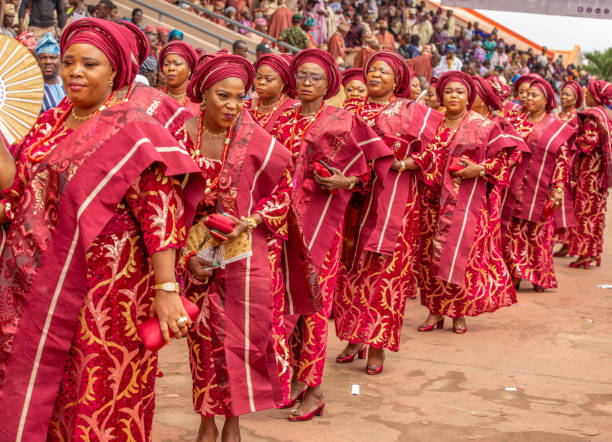
The Yorubas are people of northwest Nigeria. They can also be found in smaller concentrations in places like Benin and Togo. In Nigeria, they are one of the largest ethnic groups in Nigeria and are known for their Aso oke fabric styled into various attires that makes them stand out from other ethnic groups in the country.
While Yoruba women look resplendent in their Iro (wrapper) and Buba (matching blouse) decked with the gele (headgear) and a sash is worn over the shoulder known as ipele, the men wear Sokoto and Buba over agbada and fila, matching it with colourful beads and of course, graceful steps that exude confidence
Hausa/Fulani Traditional Attire
Occupying the northern parts of Nigeria, the Hausas and Fulanis equally have a rich collection of traditional attires that resonates with their cultural heritage. You can easily spot a Hausa man in his Babban Riga, comprised of an agbada style robe known as the juanni and Sokoto, similar to those worn by Yoruba men.
The babban riga is usually heavily embroidered at the neck region and is won with a fula (traditional cap) or turban.
The Hausa/Fulani women are distinct for their body paintings known as lali. They also wear a lot of trinkets matched with their female-type riga and zanne wrapper. They also wear veils or the Gyale (scarf) and shawls over their faces, especially at special occasions like wedding ceremonies.
In conclusion, Nigeria has a lot of traditional attires that are different amongst the various ethnic groups. These attires are representative of who we are and serve to remind us of our rich history and cultural heritage while uniting us as a people.